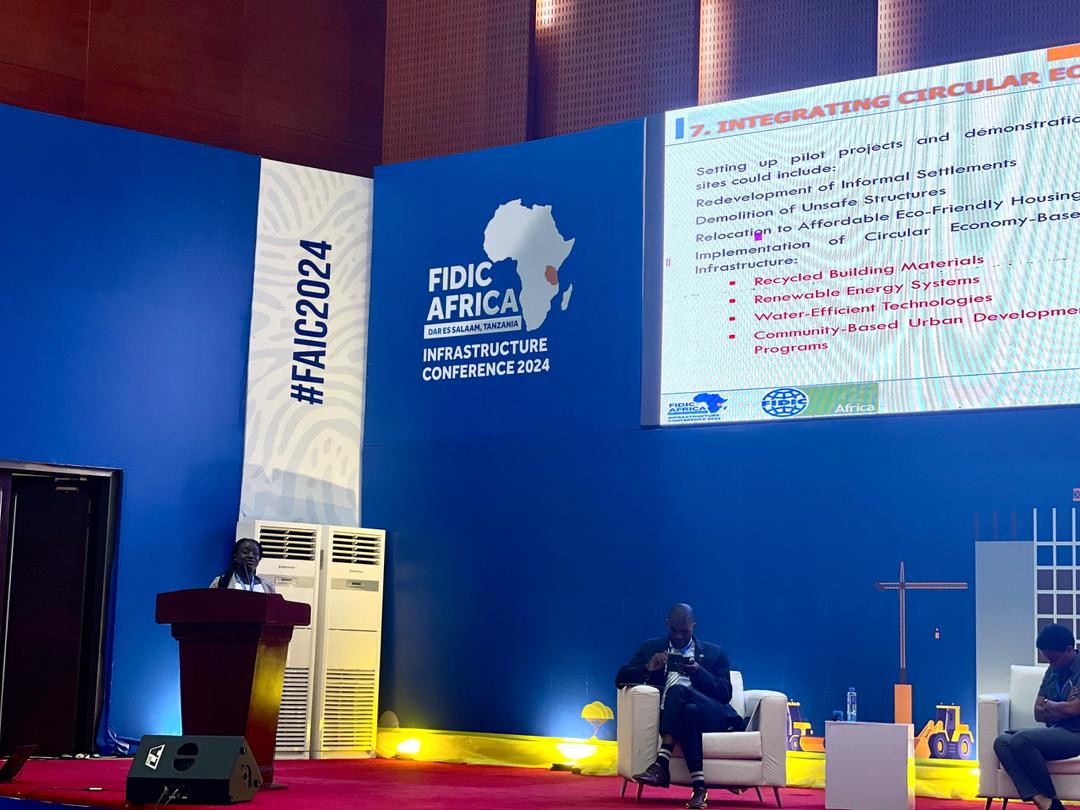
Jacqueline Sampah-Adjei, an Environmental and Sanitary Engineering Analyst and Manager for Partnerships and Business Development at Constromart, recently presented a paper at the FIDIC Africa Infrastructure Conference #FAIC2024 in Dar es Salaam, Tanzania. The topic of her presentation was “Sustainable Urban Development: Integrating Circular Economy Principles to Address Unauthorized Building Sprawl.” The paper was highly praised for its thorough research and insightful analysis of how circular economy principles can be utilized to tackle urban development challenges and promote sustainable urbanization.
During her presentation, Jacqueline highlighted the importance of integrating circular economy principles into urban planning processes. She emphasized that traditional linear economic models, where resources are extracted, used, and disposed of, are no longer sustainable in the face of rapid urbanization and population growth. By adopting circular economy principles, cities can create a more efficient and sustainable system that focuses on maximizing resource use, minimizing waste generation, and promoting economic, social, and environmental benefits.
One of the key points Jacqueline discussed in her paper was the issue of unauthorized building sprawl in urban areas. This phenomenon is common in many developing countries, where rapid urbanization often leads to informal settlements and unauthorized construction. These illegal developments not only pose safety risks and environmental hazards but also put a strain on existing infrastructure and services.
Jacqueline argued that by incorporating circular economy principles into urban planning, cities can address unauthorized building sprawl more effectively. She proposed several strategies, such as promoting sustainable building practices, incentivizing circular economy businesses, and implementing stricter regulations and enforcement mechanisms. These measures can help cities manage development more responsibly, reduce the environmental impact of construction activities, and create a more inclusive and equitable urban environment.
The audience at the conference was impressed by Jacqueline’s perspective to sustainable urban development. Many participants praised her for bringing a fresh perspective to the topic and offering practical solutions that can be implemented in real-world scenarios. Some attendees even expressed interest in collaborating with Constromart to explore circular economy initiatives in their own cities.
Overall, Jacqueline’s paper received positive feedback and sparked important discussions about the role of circular economy principles in urban planning. By shedding light on the link between sustainable development and unauthorized building sprawl, she has inspired urban stakeholders to rethink their approach to city planning and consider more holistic and environmentally friendly solutions.
In conclusion, Jacqueline Sampah-Adjei’s presentation at the FIDIC Africa Infrastructure Conference was a resounding success. Her insights on integrating circular economy principles in urban development have the potential to transform how cities manage their growth and address pressing challenges such as unauthorized building sprawl. As cities around the world strive to achieve sustainable and resilient urban landscapes, Jacqueline’s work serves as a valuable guide for designing more inclusive, efficient, and environmentally friendly urban environments.